
A Historical Deep-Dive
July's Op-Ed Expanded to 15 Points Informing 2024

July’s op-ed co-authored with Gavin Wax (and shared by a certain former President) talked about how a simple look at American electoral history can tell us what 2024 has in store for us. And as the largely self-induced (by media and partisans) chaos increases week by week leading up to it, this true north is something we all should remember. This Labor Day weekend we’ll be doubling down on this historical electoral concept and expanding on it.
For starters, all of this analysis assumes the wildest theories about candidates other than Trump v. Biden rematch go the way of well… history. It will be a rematch. Unless someone dies, you will have Trump, Biden, prospective Green Party nominee Cornell West, and possibly a No Labels candidate to choose from, in addition to a few other choices depending on your state. While the corporate media is trying to make a contest on the Republican side, while doing a radio blockout of Robert F. Kennedy Jr. on the Democrat side, the reality is the race gets further apart the harder they try.
The Republican front-runner has never lost a primary with polling leads this high. Currently, Trump leads the field in the Republican primary by nearly 40 percent in the Real Clear Politics (RCP) polling averages. So a rematch is our starting point. And given all of the bad blood and chaos of 2020, a rematch is quite frankly what the country needs at this point, which other polling shows a majority disagrees with me, but they’re wrong. And if they were right, another candidate would actually emerge, rather than theoretically emerge.
A post-recession incumbent usually loses. Regardless of what media will tell you, this country is in a recession. It’s a very weird one, as we’re experiencing inflation not seen in decades, rather than the sluggish job and economic growth we’ve been accustomed to associated with recessions, but the fact remains nearly two-thirds of registered voters, 63%, said they viewed the strength of the U.S. economy negatively, including 36% who called it “poor.” Worse for Biden, 58% of registered voters said the economy has gotten worse over the past two years, compared to 28% who said it has gotten better. Both Jimmy Carter and George H.W. Bush were also facing recession or post-recession elections when they lost.
Immigration and illegal border crossings. Since Biden’s election, America has officially had an open border whereas in prior Democrat administrations there was at least a good faith attempt to follow immigration laws currently on the books. Not so since early 2021, and it shows. While political progressives may not view immigration as a national security issue, no other Americans agree with them. Immigration and border security is a national security issue, in addition to being seen as an economic, cultural, and social issue too. Across the board—voters also disapprove of Biden’s handling of immigration. This will particularly hurt in a rematch with Trump. Because the border had been secured, and remain in Mexico and other policies pursued, what was a bigger issue in 2016 ceased to be a top issue in 2020. This will not be the case in 2024.
Crime is up in nearly every major city from 2019. Crime was one of the initial issues that tore apart the old Democrat coalition back in the 1960s. The party was increasingly associated with lawlessness. This image was successfully politically counteracted in the 1990s under Clinton and the chaos of 2020, just as it did in 1968, plays against the incumbent party in the White House. The crime wave that started in 2020 has persisted and increased in many major cities, all governed by Democrats, and with a Democrat in the White House, expect crime to be another issue that will play against Joe Biden in 2024. No amount of protests whether planned or organic will change this factor either. People have had it and ran out of patience. In particular, crime and high costs will drive more and more urban realignment away from the Democrats relative to prior elections as voters look for alternatives locally as well as nationally.
The Grover Cleveland example. If Donald Trump, despite all the odds and protestations, is able to successfully return to the White House and win in ‘24, he’ll join a list of just one other former president who returned to the presidency. In 1892 former President Grover Cleveland, a Democrat, returned to the White House after defeating incumbent president Benjamin Harrison, Republican. This election is the closest exact parallel we have to the election we’ll most likely be having in 2024. Cleveland’s coalition performed best in the electoral college for his third run in '1892, in part thanks to a third-party vote (more on that below). Here are the totals for Grover Cleveland’s three presidential campaigns (1884, 88, and 92).
Raw Vote Totals
4,914,482 votes in 1884, 5,538,163 in 1888, 5,553,898 in 1892.
Percentage Vote Totals
48.85% in 1884, 48.63% in 1888, 46.02% in 1892.
Electoral College Vote
219 EVs in 1884, 168 in 1888, 277 in 1892.
The Decisive Tipping Point States (the state that put the winning candidate over the top)
New York in 1884 by 1,149 votes, New York in 1888 by 14,373 votes for Benjamin Harrison, and in 1892 Cleveland put together his strongest electoral coalition, aided in-part by a second challenging party in the system, the Populists, drawing popular and electoral votes away from the Republicans especially in the western United States. New York and Indiana were both won by Cleveland in ‘84, lost in ‘88, and added back for ‘92, plus pick ups in Illinois, Wisconsin, and California.
Who else ran three times in the general election? Richard Nixon and Andrew Jackson. Like Cleveland before him, Nixon’s third time on the ballot was the largest electoral victory he had after a close loss and a close win. Jackson, is a frequent comparison for Trump, which I find to be only half-right (Jackson was ultimately more affiliated with the default party and civic order of his time than his detractors, won the popular vote three times, and easily won the electoral vote the second and third time). For purposes of a better electoral history comparison to our modern system, a deeper dive into Nixon’s three runs in 1960, ‘68, and ‘72 reveals…
Raw Vote Totals
34,108,157 votes in 1960, 31,783,783 in 1968, 47,168,710 in 1972.
Percentage Vote Totals
49.55% in 1960, 43.42% in 1968, 60.67% in 1972.
Electoral College Vote
219 EVs in 1960, 301 in 1968, 520 in 1972.
The Decisive Tipping Point States
Illinois, Missouri, and New Jersey by about 42,000 votes in 1960 (incredibly similar to 2020 which had about 42,000 vote difference across three states), by over 300,000 votes across Illinois, New Jersey, Ohio, and Missouri in 1968, and in 1972 Nixon won every state except Massachusetts. The third election was the strongest version of his coalition across the board.
Biden will have crossed the threshold with RFK Jr. in history as having a viable primary challenge. What is this threshold? 35% of the vote in one of the early states, and this state is likely NH. Which will remind many of the New Hampshire primary of 1968 which saw Minnesota Senator Eugene McCarthy get 42% of the vote against an incumbent president (LBJ) of his own party. Even with the media blackout of Kennedy, his name ID, willingness to campaign anywhere and everywhere, including places like with Joe Rogan’s Podcast or with Tucker Carlson which holds more contemporary relevance than MSNBC, NBC, ABC, CNN, and Fox News combined—in addition to the fact that New Hampshire allows independents to vote in the primary and the Republican primary will not be seen as competitive enough going in, I think RFK Jr. is going to vastly outperform expectations just like McCarthy did in 1968. Consider the ‘68 timeline of events, polling, leading up to the NH primary.
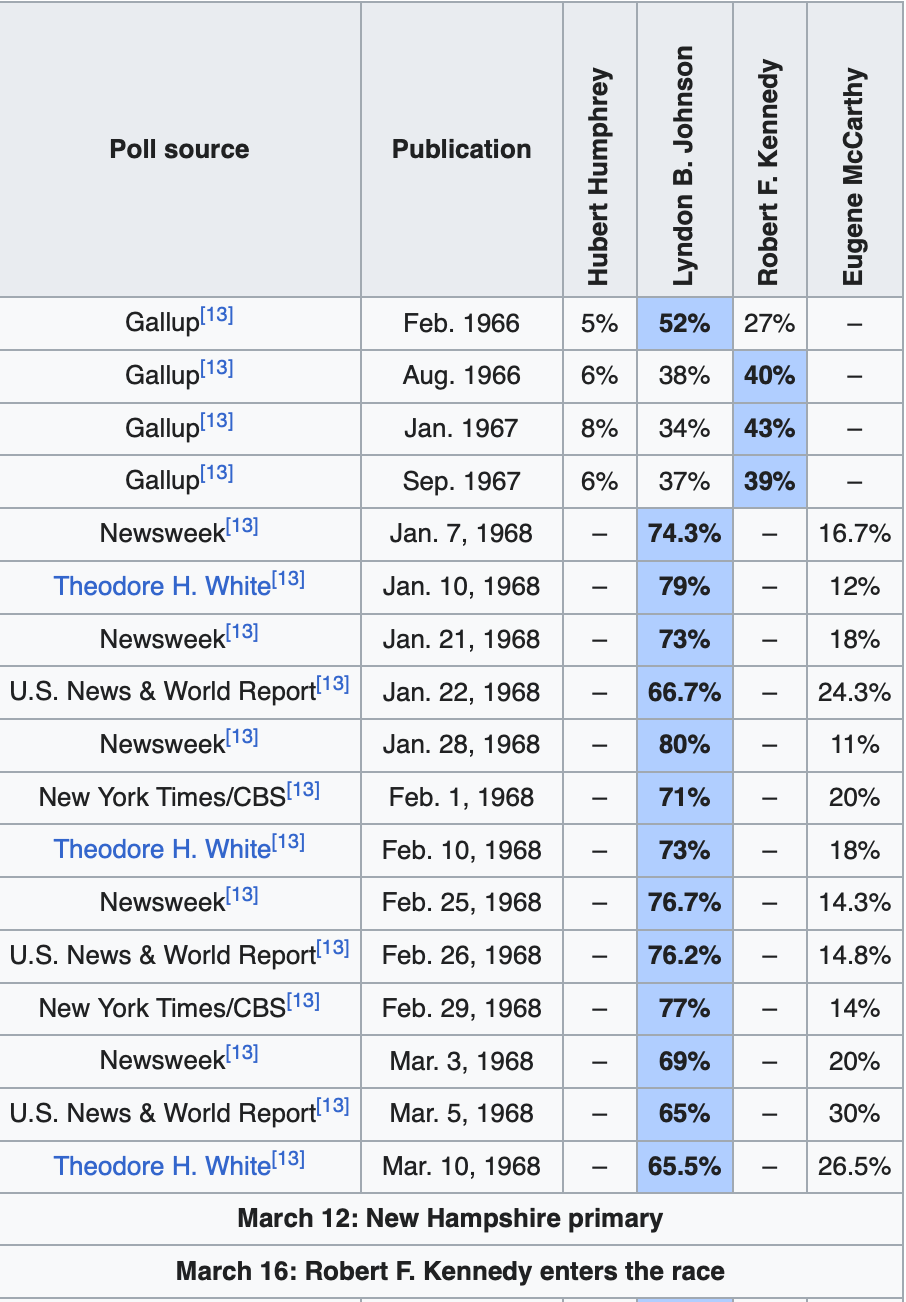
These large leads that LBJ had this far out look a lot like Biden’s large leads now. Now I’m not saying in 2024 you’ll see an LBJ “I will not run, and I will not seek” moment from Biden. If anything, I think we see a doubling down of the events of 2020. The Democratic Party of 1968 shared an overconfidence in its right to rule America with today’s Democratic Party, but the reality is it’s significantly weaker and the overreaches and media propaganda diet we see daily is a testament to that fact. In addition to the 1968 example, in 1980 on the Democratic side, and in 1992 on the Republican side, there were similar viable primary challenges to an incumbent president. To be “viable” the challenger from within the party does not need to win a single state, just needs to be competitive to weaken an incumbent president.
South Carolina will again put Biden over the top in the primary, securing his place as the Democrat nominee. After underperforming in New Hampshire Biden gets the same state (moved up and front-loaded in the calendar now beyond its historical third state status) that bailed him out and made him the nominee in 2020. Two forces drove the party to close ranks so quickly in 2020. First, the emerging coronavirus pandemic, and second, the need to stop Bernie Sanders (who is in my view, a fake populist, or rather a populist for the “aspiring professional class”) from getting the nomination amongst the donor class. Sanders committed two sins against the modern Democratic Party. One, the donor class did not like him. And two, he appeared insufficiently committed to the identity politics religion of the modern Democrats. These two forces are intertwined, and it’s why the donor class and corporate America will tolerate any move to destabilize American culture and society, but not any significant change in foreign affairs or the structure of the economy. Identity politics is quite simply the glue that keeps the fragile Democrat coalition together. While patriotism, and I would argue increasingly, family politics — is the glue that keeps the Republican coalition together. Many will say it is “tax cuts”, and while that may be true for the donor class of the GOP, it’s never really been true for the most populist grassroots.
Close states broke Trump’s way in ‘16, and broke against him in ‘20 but the margin of loss was closer than his margin of win, and his current RCP average is higher vs. his opponent than it has ever been historically. Heading into 2016 election night, Clinton led by 3.2 in the RCP average and ended up winning the popular vote by 2.1, while the tipping point states of WI, PA, and MI diverged by about 3 points from the national average tipping the election to Trump. The divergence of these states continued into 2020. Heading into 2020 election night, Biden led by 7.2 in the RCP average and ended up winning the popular vote by 4.5, while the tipping point states were WI, AZ, and GA by even closer margins. This overall 2.5 national trend vs. a smaller by-state trend in states like WI, PA, and NC, is significant. Today, the RCP average sits at 0.7 for Biden. Outside of a brief couple of day period in July, 2016, Trump is polling better against his Democratic opponent than he ever has.
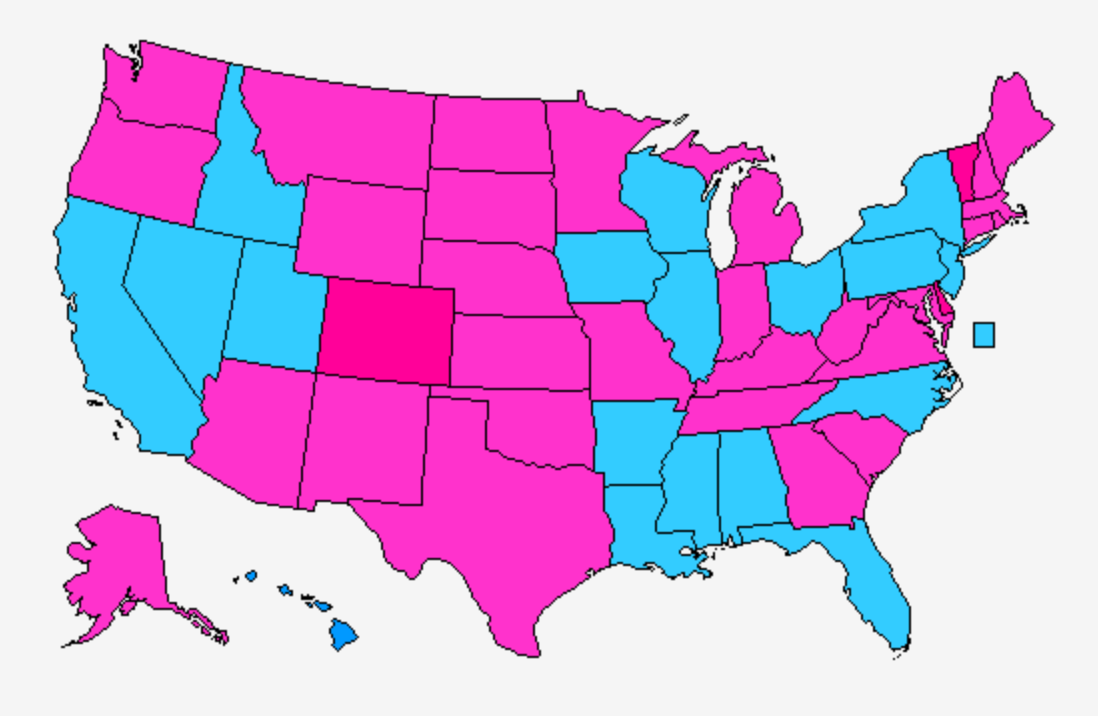
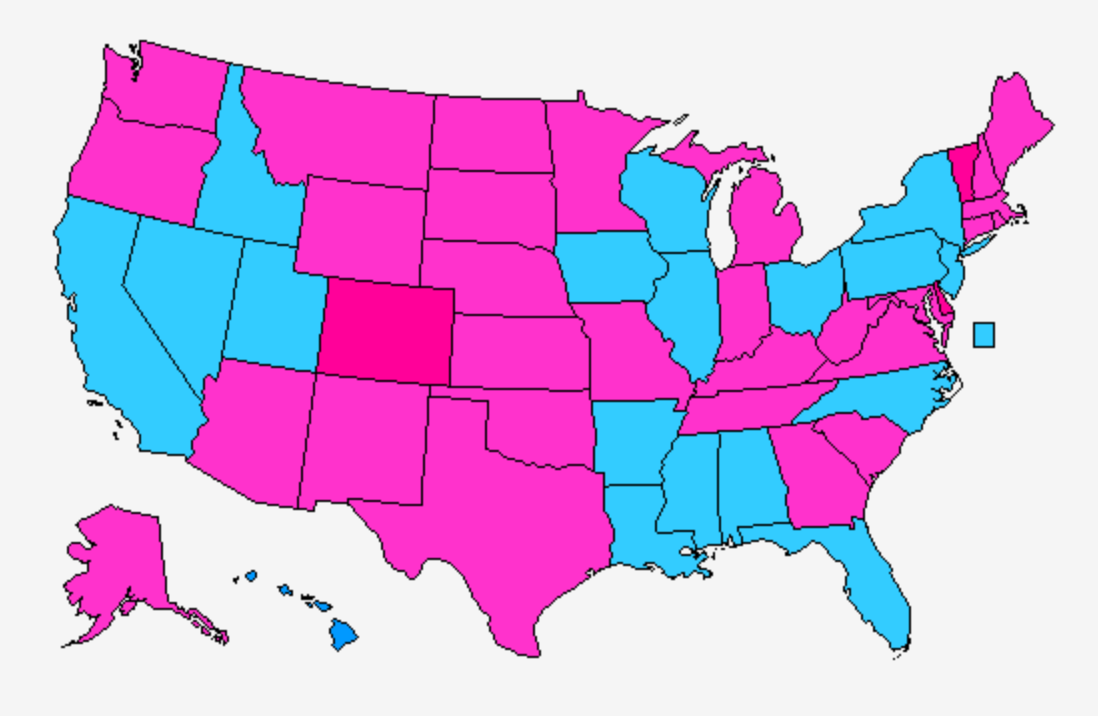
The states in pink/red trended Democrat, the states in blue trended Republican. Most of these states saw very little changes compared to history and most elections, which is common for an incumbent president vs. challenger type elections. Note that several states critical to Trump’s 2016 coalition, still trended Republican (WI, PA, OH, IA, FL, and NC), as did a potential state that could be added for 2024 — Nevada. The third-party factor. Both Cleveland and Nixon had a significant third-party factor going in one of their elections. Cleveland was helped over the finish line in 1892 with the presence of the Populists, who in the era when fusion balloting was useful instead of antiquated, meant that they teamed up with Democrats in Republican strong states and teamed up with Republicans in Democrat strong states. Nixon also was helped in 1968 by the third-party vote. People forget this because they have been propagandized by the asinine “switch” theory, but the reality is the Wallace electoral votes in 1968 were previously Democratic for LBJ in ‘64, and would later return to the fold for Jimmy Carter in ‘76. Now, Democrats would’ve still needed a few other states to win in ‘68, but the fact remains that historically the third-party vote factor hurts incumbent presidents or incumbent parties regardless of ideological orientation. In 2016 there was just barely a significant third-party vote of around 5 percent, and by 2020 it was nearly nonexistent. By and large, Biden’s margins were from the third-party voters from 2016 as he won 3 out of every 4 that realigned to a major party candidate. So even though the vote total was lower, the third party factor still played against the incumbent president. In 2020, the likely Green Party candidate Cornell West will have ballot access in battleground states like Wisconsin, Michigan, and Maine, and states that I don’t actually think will be battlegrounds like Florida, North Carolina, and Florida. Any potential No Labels candidate who emerges, even if that candidate is former Maryland Governor Larry Hogan, a Republican, votes for him will still play against the incumbent president because voter ideology does not matter with third-party voters. Every third party vote is a potential vote the incumbent president did not earn, and does not get. For voters that dislike both Biden and Trump this will be especially significant as it will give those voters a place to go. Even if those voters were to otherwise split 50/50 it will still end up hurting Biden because he won a majority of 2016 third party voters in 2020. Currently, the No Labels effort, without a candidate even, has ballot access in states like North Carolina, Florida, Arizona, and Nevada. With two third-party options potentially in Florida and North Carolina, neither one of those states is going to be a battleground in a close election. And the No Labels presence on the ballot in Arizona and Nevada may be decisive electorally.
The dying Republican establishment is about to go the way of the Bourbon Democrats, Al Smith’s Democrats, and the Blue Dog Democrats. Much of the Never and anti-Trump fervor is actually driven by former Republicans or Republicans who have stayed within the party still, but in name only. This is basically the old Bush-McCain-Romney Republican establishment that even after Trump has no interest in winning national elections. This crowd is much older than the base, it is also whiter, male-heavy, and fulfilling the historical role shared by Democrats like Al Smith historically, who turned into a fierce critic of the New Deal as the prior Democratic nominee for president. This is actually quite common and can be seen throughout history with once significant but now discarded and died out parts of old coalitions.
The corner and border states that have historically voted together are moving away from one another or rather they are flipping partners. One significant observation of many in The Emerging Republican Majority by Kevin Phillips was that the corner (northeast and northwest) of the country and middle northern border trio of Minnesota, Wisconsin, and Iowa often voted together. Or rather, MN/WI/IA voted with WA/OR. This consistency can be particularly seen after that book was published in the late 1960s when MN, WI, and IA joined WA and OR in breaking from the Reagan coalition in the 1988 election, voting for Dukakis over Reagan’s VP George H.W. Bush. Although Bush won in an electoral landslide (the last one we’ve had in this country) you could see this correlation almost perfectly from 1988 through 2012. In 2016 however, Iowa voted for Trump and Wisconsin voted Republican for the first time since 1984. Minnesota got very close to voting Republican as well. What happened in Washington and Oregon? It started voting closer to California. So what is the corner and northern border correlation post-2016. I posit that it is MN/WI/IA to Maine and New Hampshire. In both 2016 and 2020, Maine’s second congressional district voted Republican for the first time since Maine started splitting their votes by district, and New Hampshire got very close in 2016 just like Minnesota did.
This plays into the long-term electoral math of the country. There is a solid batch of electoral votes that can fall into Republican hands with a 3 to 7 percent movement whereas there is only one state doing that for movement overall toward the Democrats. You can forget about Democrat dreams of a blue Texas, North Carolina, or even the assumption that Arizona or Georgia are actually realigned. From Obama era, only Colorado has truly realigned, while Virginia remains very winnable for the right type of Republican candidate and the right electoral environment. From the Trump era, Ohio, Florida, and Iowa are truly realigned, and several more states with an additional 3 to 7 percent national trend would flip as well (see below). If Biden actually won by the 7 percent RCP average last time, he would have picked up just one additional state—North Carolina. If he more or less ties the popular vote as current averages show, then he stands to lose a handful of states if trending is uniform or even close to it, as it mostly was at the state level for 2020.
There’s a new demographic inevitability in town. For years Democrats have assumed the changing American demographics favored them. The last few years have consistently pointed out there is no longer evidence for that, and if anything — there is evidence of long-term favorable demographics pointing the other way. Consider the 2022 midterms, Republicans won married men by 20, married women by 14, unmarried men by 7, and got crushed with unmarried women by 37. Increasingly, single women are single-handedly keeping the Democrat Party afloat. This isn’t surprising given how hostile to families and parents Democrats increasingly are. Ignoring the social and cultural aspects and trying to win over parents and families with economic issues isn’t helping the Democrats cause either as they are increasingly perceived as not the preferable party on economics at large, and specifically on middle and working class home economics. There is an organizing element to this too. Consider that the closest thing to a grassroots Tea Party today is arguable made up of and driven by women, specifically mothers. The group Moms for Liberty may be new to the scene as of the ‘22 midterms, but they proved potent. The conservative parents’ rights group first sprung up during the COVID lockdowns. As of last year, it had 80,000 members in 34 states; and this year, it now claims 285 chapters in 45 states with more than 120,000 members. And while it is clear that Republicans took a short-term loss with the end of Roe v. Wade electorally, the long-term gain stands to be much greater.
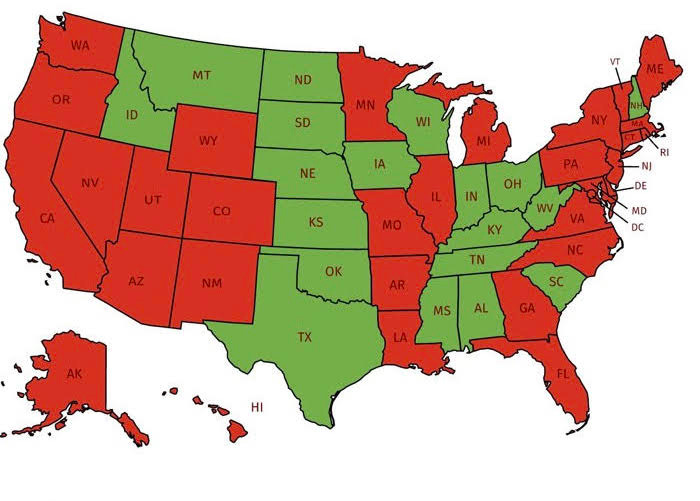
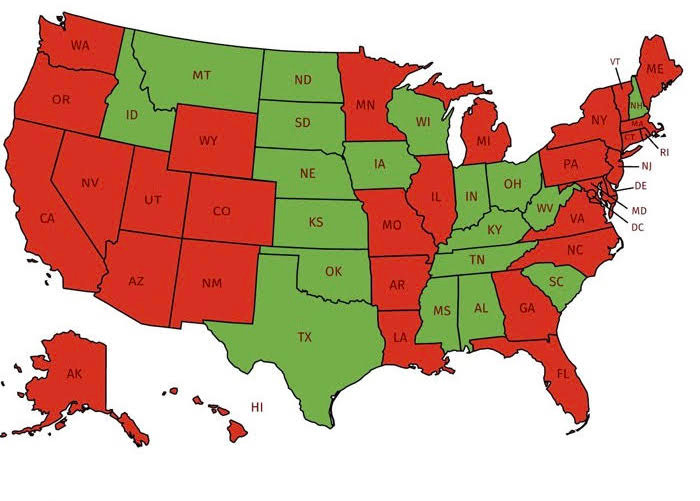
The states in red represent states where birthrates declined from 2022 to 2023. The states in green represent states where birthrates increased. This nearly looks like the electoral map, although not quite. But what it really means is that Democrats, and especially progressives, are not having children. The new demographics-is-destiny favors Republicans, and just like the working and middle class realignments, the family realignment is happened across the board too.
Continued realignment from Hispanics, Asians, and black men, add to and diversify the new populist base. 2020 saw Trump increasing his support from every single racial demographic except white men. He performed as well as he did in 2016 with white men but lost most of the third party voters to Biden. In 2024, all data points to Trump exceeding his 2020 raw and percentage totals with Hispanics, Asians, and black men.
The indictments and weaponization of the government against a former President is turning Trump into an electoral and national martyr. He is polling stronger than he ever did in 2016 and 2020. Given the realities informed mostly from history (time and again, a more reliable place for wisdom than science it is), all of this taken together gives us a big window into why the Democrats are throwing politicized indictment after indictment Trump’s way, and ultimately behaving like the monarchs of history do in their finals years and days of their reign. Increasingly, America is not so much divided between left and right, Republican and Democrat, but between the establishment and populist influenced anti-establishment forces. And it is the latter message that has always given Donald Trump his power and continues to make him the odds-on-favorite to join Grover Cleveland on the list of presidents who served two non-consecutive terms.
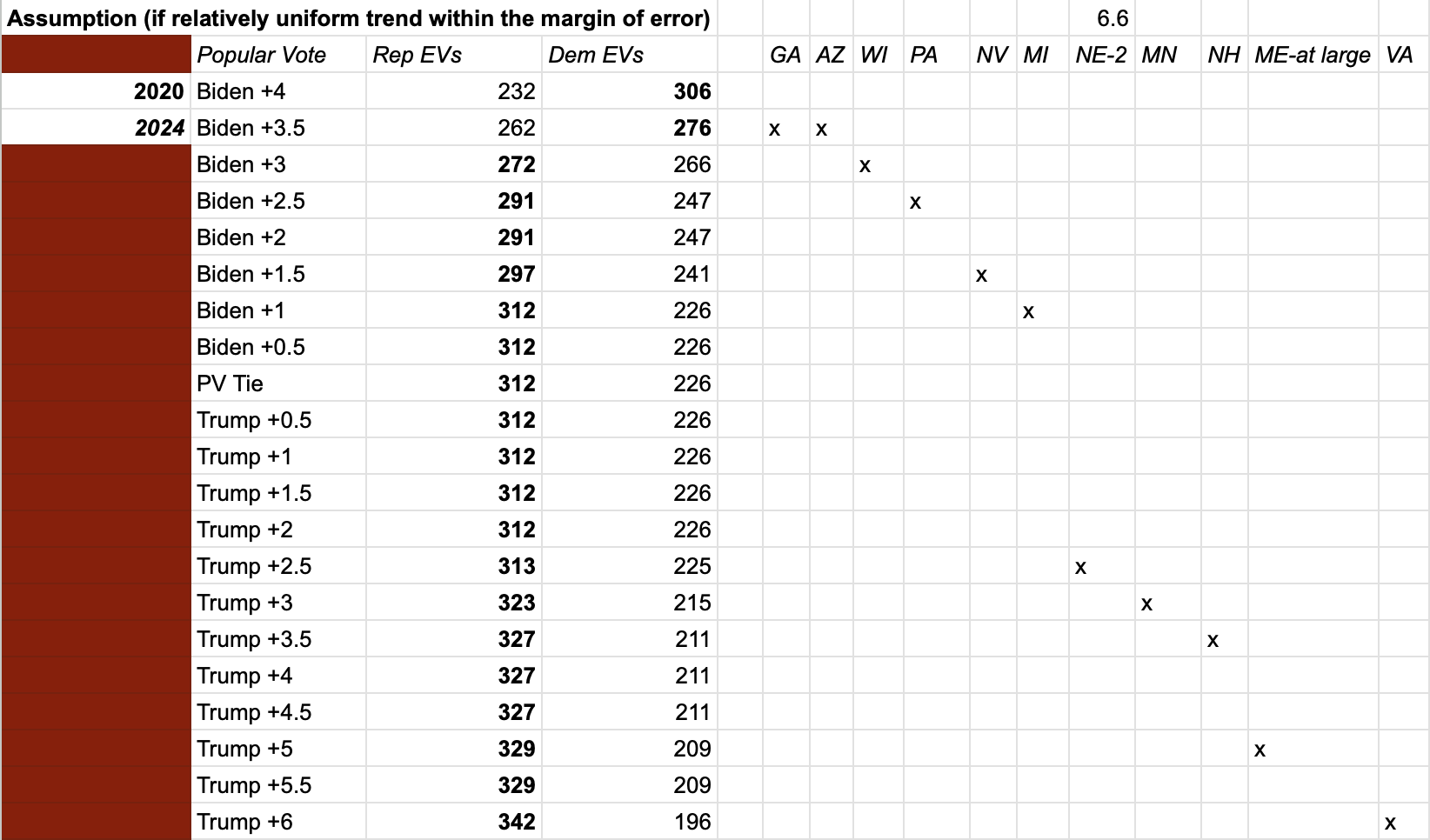
Donald Trump’s first two presidential campaigns in 2016, 2020, and an early projection of his third based on some of the history discussed above (2024).
Raw Vote Totals
62,985,153 votes in 2016, 74,225,845 in 2020. (76 million in 2024)
Percentage Vote Totals
45.93% in 2016, 46.80% in 2020. (48.3% in 2024)
Electoral College Vote
306 in 2016, 232 in 2020 (312 in 2024)
The Decisive Tipping Point States
Wisconsin, Pennsylvania, and Michigan in 2016 by a total of 77,000 votes across the three states, Arizona, Georgia, and Wisconsin by a total of 42,000 votes across the three states. Between these two elections, these five states plus Nevada figure to be the tipping point states of 2024.
Troy M. Olson is an Army Veteran, lawyer by training, and the co-author (with Gavin Wax) of the upcoming book entitled ‘The Emerging Populist Majority.’ He lives in New York City with his wife and son. You can follow him on Twitter and Substack at @TroyMOlson